Music, Math, and Reading: The Cognitive Connection
How music builds math skills through pattern recognition - Music's role in reading development - Working memory and attention for learning - Why early structured practice matters
Albert Einstein played violin. Mathematician Eugenia Cheng performs as a concert pianist. Physicist Max Planck was an accomplished organist and composer. Physicist Richard Feynman played bongo drums. Astronomer William Herschel, who discovered Uranus, began his career as a professional musician.
For a long time, this pattern was treated as coincidence — interesting biographical detail, nothing more. Brilliant people, the thinking went, tend to have multiple talents. Their musical ability and scientific achievement existed in parallel, unrelated.
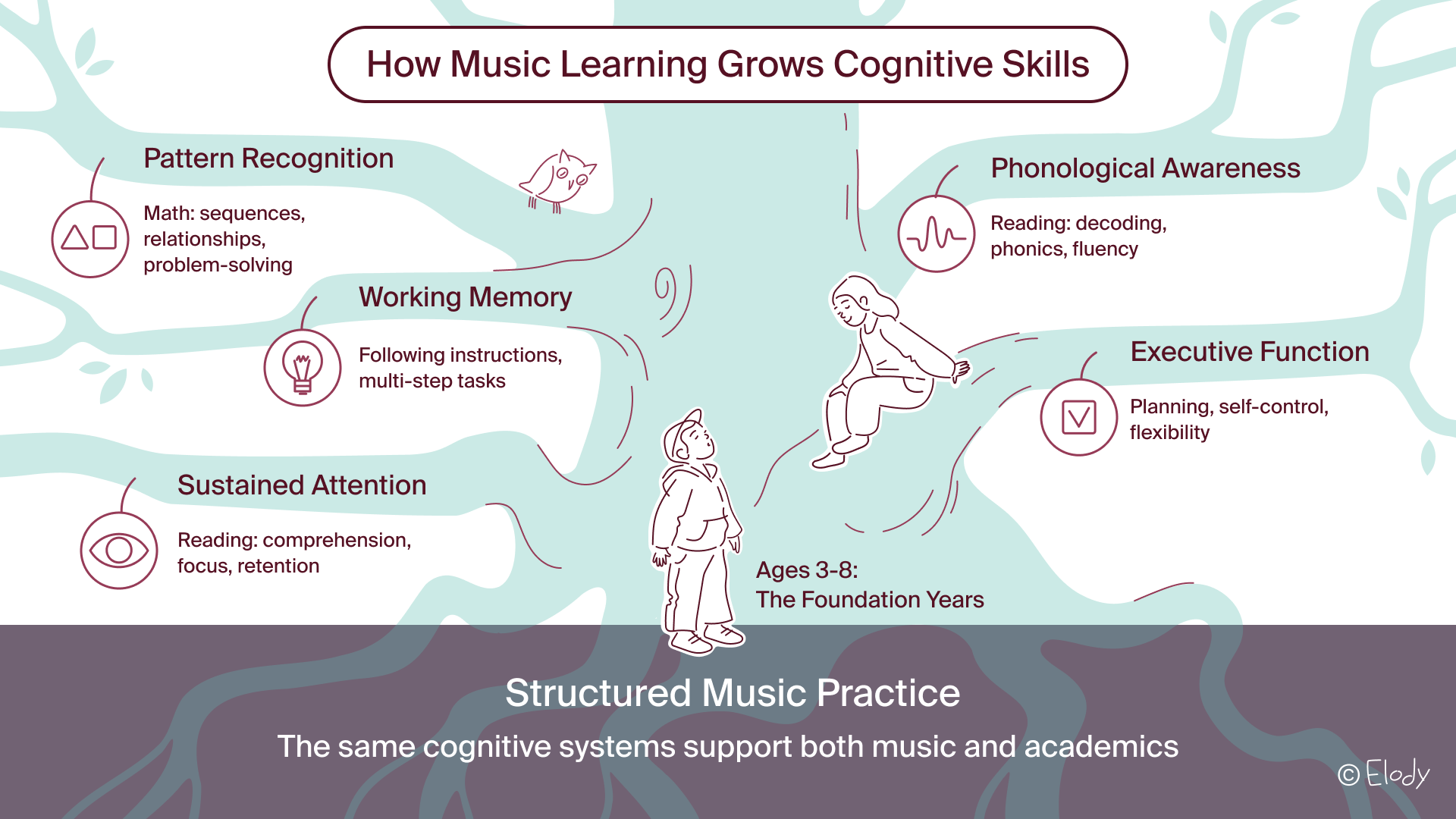
Research in the late twentieth and early twenty-first centuries told a different story. The connection between musical training and cognitive capacities that support scientific and mathematical thinking isn't coincidental. It's grounded in how the brain develops fundamental skills — pattern recognition, abstract reasoning, working memory, sustained attention — that both music and academic disciplines require.
Understanding this connection doesn't mean treating music as merely a tool for boosting test scores. Music matters in its own right. But it does help explain why structured music learning during early childhood creates cognitive advantages that extend far beyond musical performance.
Pattern Recognition: The Foundation for Math Skills
Mathematics and music are both pattern-based disciplines. Numbers follow rules, relationships, and predictable sequences. So do melodies, rhythms, and harmonic progressions.
When children learn to recognize that a melody moves up or down, or that a rhythm pattern repeats, they're exercising the same cognitive capacity they use to recognize that numbers increase by twos, or that shapes follow a sequence.
Research on mathematical cognition shows that children who receive structured music training demonstrate stronger pattern recognition skills than children without that training. This advantage appears in tasks that have nothing to do with music — recognizing numerical sequences, completing visual patterns, understanding mathematical relationships. (Rauscher et al., 1997; Vaughn, 2000; Hetland, 2000)
The mechanism isn't mysterious. Pattern recognition is a domain-general skill. When children practice recognizing patterns in one context, they strengthen neural pathways that support pattern recognition in other contexts as well.
In Elody, we structure activities specifically to highlight patterns. Children listen for rhythm patterns that repeat. They practice recognizing when melodies move up or down. Every activity asks children to notice relationships, remember sequences, and identify what's similar or different.
We're teaching music — but we're also building the cognitive architecture that makes mathematical thinking possible.
How Music Strengthens Working Memory for Learning
Working memory is the cognitive system that holds information temporarily while you manipulate it. It's what allows you to remember the beginning of a sentence while you process the end, or hold several numbers in mind while solving a math problem.
Working memory capacity in early childhood predicts academic achievement more reliably than IQ scores. Children with stronger working memory learn to read more easily, solve math problems more flexibly, and follow multi-step instructions more successfully. (Alloway & Alloway, 2010)
Musical activities place consistent demands on working memory. To recognize whether two melodies are the same, children must hold the first melody in memory while listening to the second. To clap a rhythm pattern after hearing it, they must remember the sequence accurately enough to reproduce it.
These aren't performance demands — they're memory demands. And repeated practice with these demands strengthens working memory capacity itself.
Research shows that children who receive structured music training show measurable improvements in working memory tasks, including tasks that involve no musical content. The training transfers because the underlying cognitive system — the ability to hold and manipulate information — is the same. (Roden et al., 2014; Bugos & Mostafa, 2011)
When we designed Elody's activities, we paid close attention to working memory load. Early activities ask children to remember short, simple patterns. As children progress, the patterns become longer and more complex.
This gradual increase in difficulty doesn't just teach music — it systematically exercises and strengthens working memory capacity in a way that supports learning across domains.
Building Attention Skills That Support Reading
Reading requires sustained attention. Children must focus on text long enough to decode words, hold meaning in mind, and integrate information across sentences and paragraphs. This isn't a skill children are born with — it develops through practice.
Musical activities, particularly those that emphasize careful listening, build exactly this capacity.
When children listen for whether a melody goes up or down, they must sustain attention from the beginning of the phrase to the end. When they recognize a pattern that repeats, they must maintain focus across multiple repetitions.
Research on attention development shows that structured musical activities improve children's ability to sustain attention, ignore distractions, and maintain focus on relevant features of a task. (Moreno et al., 2011; Tierney & Kraus, 2013)
These improvements show up in non-musical contexts. Children who participate in music training demonstrate better attentional control in classroom settings, stronger ability to filter out irrelevant information, and more consistent focus during academic tasks.
The mechanism is straightforward: sustained attention is a skill, and musical listening provides repeated, engaging practice in sustaining attention. That practice transfers.
In Elody, we structure every activity around focused listening. The narrator provides context, the activity presents a clear task, and children must listen carefully to respond correctly.
Over weeks and months, this daily practice in sustained, focused listening builds the attentional capacity that supports reading comprehension, following instructions, and engaging with academic content.
Music and Phonological Awareness: The Reading Connection
One of the strongest connections between music and academic skills appears in early reading development, particularly in phonological awareness — the ability to recognize and manipulate sounds in language.
Children with strong phonological awareness learn to read more easily because they can hear the individual sounds that letters represent. They can segment words into syllables, recognize rhymes, and blend sounds to form words.
Musical training strengthens phonological awareness because music requires precise auditory discrimination. Children who learn to distinguish between similar pitches, recognize small differences in rhythm, and identify subtle changes in melody develop more sensitive auditory processing overall.
This sensitivity transfers directly to language. Research shows that children with music training demonstrate stronger phonological awareness, better speech perception in noisy environments, and faster development of reading skills. (Degé & Schwarzer, 2011; Strait et al., 2010)
The neural mechanisms are well-documented. Musical training enhances auditory cortex responses to speech sounds, strengthens neural encoding of linguistic pitch patterns, and improves the brain's ability to track rapid changes in auditory information — all processes that support reading development.
This is one reason Elody focuses so heavily on pitch discrimination and melodic recognition. We're not just teaching children to hear musical differences — we're strengthening the auditory processing systems that make reading possible.
Executive Function: Self-Regulation for Academic Success
Executive function — the set of cognitive processes that include planning, focusing attention, remembering instructions, and managing multiple tasks — develops dramatically during early childhood. Children with stronger executive function show better academic outcomes, stronger social skills, and more successful learning trajectories. (Diamond, 2013)
Musical activities provide natural practice in executive function. Following a musical game requires listening to instructions, inhibiting impulsive responses, remembering rules, and adjusting behavior based on feedback. These are executive function demands, and meeting them repeatedly strengthens the underlying cognitive systems.
Research comparing children who receive music training with those who receive other forms of enrichment shows specific advantages in executive function tasks. Musical training groups show stronger inhibitory control, better task-switching ability, and more flexible problem-solving. (Moreno et al., 2011; Jaschke et al., 2018)
In Elody, executive function demands are embedded in every activity. Children must wait for their turn to respond, remember what they're listening for, stop when the activity ends, and adjust their responses based on feedback. These aren't just behavioral expectations — they're cognitive exercises that build self-regulation skills.
Why the Transfer Effects Matter
Understanding these connections doesn't mean treating music as merely instrumental — as valuable only because it improves math scores or reading fluency.
Music matters in its own right. The ability to make music, understand musical structure, and respond emotionally to sound is valuable regardless of whether it improves academic performance.
But the cognitive benefits are real, and they matter for children's development. When we choose how to spend limited time and resources on early learning, understanding that music learning builds capacities that support learning across domains helps parents make informed decisions.
The goal isn't to use music to boost test scores. The goal is to recognize that structured music learning during early childhood strengthens cognitive capacities — pattern recognition, working memory, sustained attention, phonological awareness, executive function — that children need for all learning.
These aren't side effects. They're integral to how musical learning works. You can't practice pitch discrimination without strengthening auditory processing. You can't recognize rhythm patterns without exercising pattern recognition. You can't follow musical activities without building attention and memory.
The academic benefits emerge naturally from the cognitive demands that musical learning places on children — not as separate outcomes that require separate effort, but as inherent consequences of learning music well.
Questions Parents Often Ask
Does music education really improve math and reading skills?
Yes, the research is substantial and consistent. Structured music training is associated with measurable improvements in pattern recognition (which supports math), phonological awareness (which supports reading), working memory, and sustained attention — all cognitive capacities that make academic learning easier.
However, music isn't magic. The benefits come from consistent, structured practice over months and years, not from casual exposure. Music training strengthens the underlying cognitive capacities that support academics, but it's not a replacement for math and reading instruction itself.
The evidence supports the connection, but it's important to maintain realistic expectations. Music learning builds cognitive skills that transfer to academics, but doesn't guarantee academic success on its own.
What age should children start music learning?
The research on brain plasticity suggests that ages 3-7 represent a critical window when auditory development is most active. Starting structured music activities during this period allows children to build listening skills when their brains are most receptive to them.
However, it's never too late to start. Children (and adults) of any age can benefit from music learning. The key is finding age-appropriate activities. Very young children (3-5) benefit most from play-based listening activities rather than formal instrument instruction. Around age 5-6, many children are ready for piano or violin lessons. Wind and brass instruments typically wait until age 8 or older.
For early childhood (ages 3-7), the focus should be on ear training, rhythm, and musical play rather than performance or reading notation. These foundational skills make later instrument learning much easier.
How much music practice do young children need to see cognitive benefits?
Research suggests that benefits emerge from consistent, frequent practice rather than long sessions. Studies showing cognitive improvements typically involve 20-30 minutes of structured musical activity, 3-5 times per week, sustained over several months.
For young children specifically, shorter sessions matched to their attention span work better than trying to force longer practice times. Elody is designed for flexible practice times that match developmental attention spans: younger children (ages 4-5) benefit from 5-10 minute sessions, while older children (ages 6-9) can sustain focus for 15-30 minutes.
The key isn't duration — it's consistency. Daily practice, even brief sessions, produces better outcomes than infrequent longer sessions. The brain needs repeated exposure to consolidate learning.
Can music apps replace traditional music lessons for young children?
Music apps and traditional lessons serve different but complementary purposes. Apps can provide structured daily practice in ear training, rhythm recognition, and pattern identification — exactly the foundational skills that support cognitive development. Traditional lessons add instrument technique, personalized feedback, and social learning through group classes or recitals.
For young children (ages 3-6), app-based ear training can actually be more developmentally appropriate than formal instrument lessons. Children this age aren't always ready for the fine motor demands or extended focus that instrument lessons require, but they can engage meaningfully with listening activities presented through games and stories.
The question isn't whether apps replace lessons, but whether children are getting structured musical practice that builds genuine skills. Well-designed apps focused on listening and pattern recognition can provide that foundation, which then makes instrument lessons more successful when children are ready for them.
What type of music training is best for cognitive development in young children?
The research distinguishes between structured training and passive exposure. Structured activities — those that require focused listening, pattern recognition, and active response — produce measurable cognitive benefits. Passive listening, while enjoyable and culturally valuable, doesn't show the same cognitive effects.
For young children specifically, ear training and rhythm activities produce the strongest cognitive benefits. These activities emphasize auditory discrimination, pattern recognition, and working memory — the capacities most closely connected to early academic skills.
Instrumental training also shows benefits, but the cognitive advantages come primarily from the listening and pattern recognition involved, not from the motor skills of playing. This is why ear training before instrument lessons can be so effective — it builds the perceptual foundation that makes instrument learning easier and more meaningful.
What This Means Practically
Music learning during early childhood isn't just about music. It's about building cognitive capacities that support learning across domains — capacities children need for reading, mathematics, problem-solving, and sustained attention to challenging tasks.
This doesn't mean treating music as merely instrumental, as valuable only for its academic benefits. Music matters in its own right. But understanding the cognitive connections helps clarify why structured music learning during early childhood is time well spent — not despite being "just music," but because music engages and strengthens fundamental learning capacities.
If you're interested in giving your child structured music practice that builds both musical understanding and broader cognitive skills, that's exactly what we're building with Elody.

Join our waitlist for updates and occasional sneak peeks of what we're building. You can also follow our progress on Instagram, TikTok, and Facebook.