Creating Elody: A Kids’ Learning App Teaching Music—and Thinking
Why music matters a lot in cognitive development - What children actually learn - How learning works - Why story-based guided play matters
Scrolling through color-noisy and effects-heavy children’s apps, we thought: What if children could learn fundamental music and cognitive skills easily and joyfully — the way they learn a native language? That’s what we’re doing with Elody — an early learning app for kids that turns music into daily, guided practice, strengthening musicianship and essential thinking skills.
Elody is being built by a focused team with deep experience in early childhood education, music pedagogy, and product design, supported by an expert advisory board. The product is shaped by research, real-world teaching practice, and close collaboration around a shared goal: using modern technology to make early learning both rigorous and joyful.
Why music — and why it matters beyond music
“Mathematics, chess, and music.” That’s how one parent once described to me the three pillars she sees as essential for her child’s development.
It’s not a random list. Like mathematics and chess, music unfolds over time. It asks children to pay attention, anticipate what comes next, recognise patterns, and adjust when something changes. These are not artistic extras — they are cognitive skills closely tied to how children learn across domains.
Research in child development and neuroscience shows that structured music learning is associated with measurable improvements in attention, working memory, auditory processing, and executive function — cognitive abilities that support learning across domains. (Rodriguez-Gomez et al., 2022; Kraus et al., 2010; Trainor et al., 2009)
In Elody, music becomes a practical way to exercise these abilities — through repeated, meaningful practice embedded in everyday learning, supporting whole-child development and strengthening children’s capacity to learn mathematics, languages, and beyond.
What children actually learn in Elody
Elody builds a practical, transferable foundation in early musicianship — one that supports both joyful music-making and a confident path into more formal music learning.
At the core of this foundation is early ear training: learning to listen carefully, recognise patterns, and notice meaningful differences in sound. These listening skills shape how children understand music long before performance or formal study becomes relevant.
Children develop a steady sense of beat, recognise rhythm patterns, and learn how melodies move — up and down, in steps and small skips. They begin reading simple notation on the staff, gaining familiarity with how music is written as well as how it sounds. Over time, they also build an understanding of pitch relationships and early harmony, learning to recognise the difference between major and minor sounds and how each one shapes the mood and character of music.
Because these skills are practiced through structured, repeatable activities, children develop more than musical understanding. They learn essential learning habits: starting and stopping on a cue, listening while performing, responding to changes in tempo and dynamics, and recognising the sounds of common instruments. Attention, timing, and responsiveness are exercised naturally as part of the musical task.
The result is a confident musical base that transfers easily — equally suited to meaningful music-making at home and to a smooth start in choir, piano, strings, or classroom music. At the same time, children strengthen broader cognitive skills such as focus, pattern recognition, working memory, and adaptive listening — abilities that support learning well beyond music.
How learning with Elody works
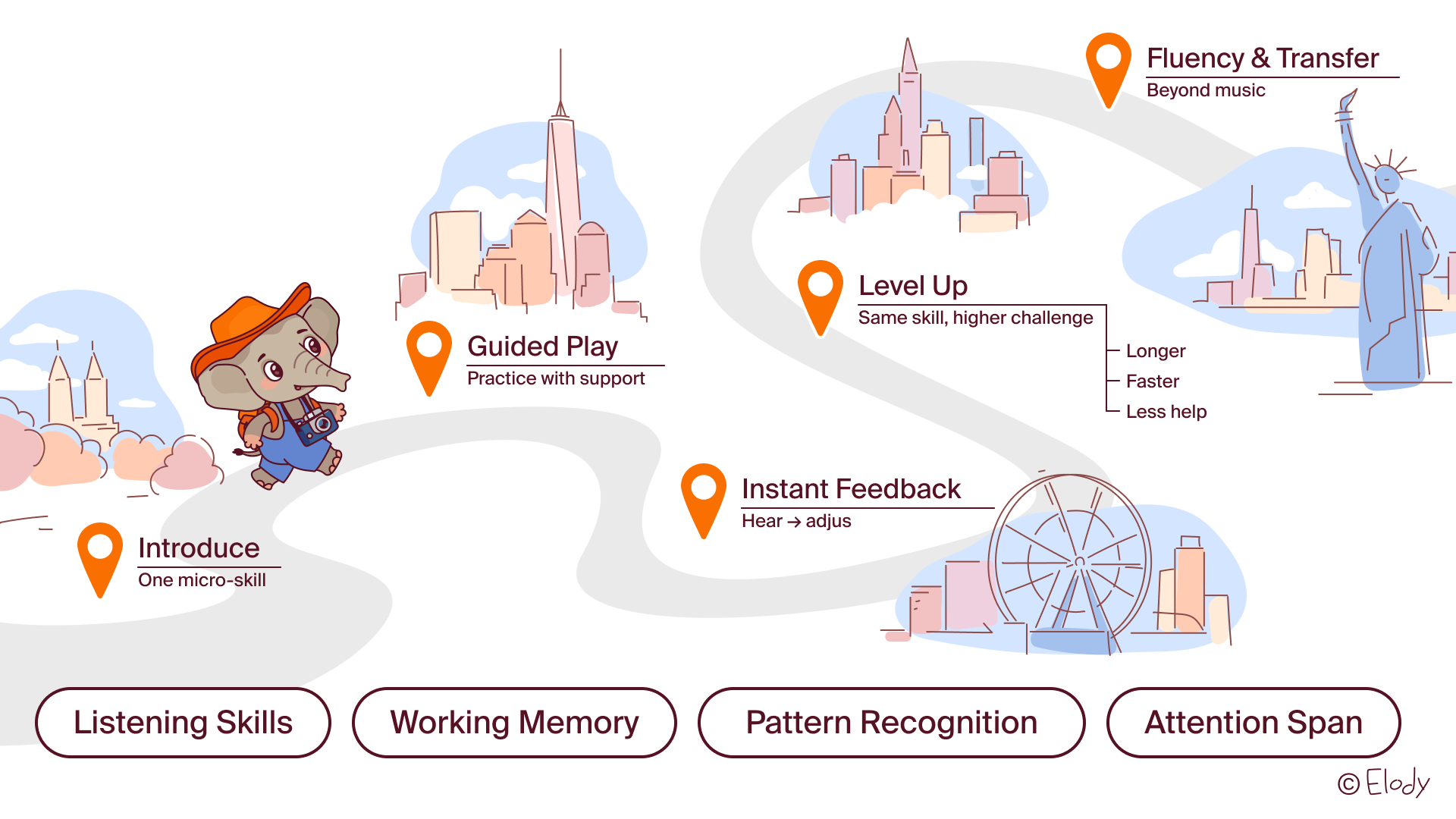
Learning in Elody follows a deliberately progressive structure. Children begin with simple, bite-sized musical ideas paired with clear visual and auditory cues, then move step by step toward more complex concepts. As in mathematics, early clarity around simple ideas makes later skills feel natural rather than overwhelming. This progression lays a strong foundation for solfège, which can otherwise feel abstract or difficult when introduced too early.
Within this structure, learning unfolds through story-based, emotionally engaging play. A warm, steady narrator provides a familiar presence that helps children stay focused and relaxed. Friendly characters introduce carefully designed learning games, each centered on a single musical concept — accurate listening, rhythm, relative pitch, melodic contour, intervals, or early notation. By isolating one skill at a time, Elody allows children to practice deeply, without distraction.
To support real learning, musical ideas return over days and weeks. Children revisit concepts, refine understanding, and progress at a comfortable, unhurried pace. Difficulty increases gently, feedback is immediate, and progress is built through many small successes. Over time, repetition becomes fluency — and fluency is reinforced by strong learning habits rooted in clarity and consistency.
Why story-based guided play matters
In Elody, story functions as a child-friendly learning framework — using friendly animal characters and gentle narrative cues to guide attention, pace learning, and introduce musical ideas through a rich, coherent view of the world, where music connects naturally to sounds, movement, nature, and everyday experiences.
Research on early learning supports guided play — an approach that combines the openness of play with intentional learning goals. In guided play, children remain active participants, while the environment quietly directs attention toward specific skills. (Zosh et al., 2018; Weisberg et al., 2013)
In Elody, stories create context and emotional continuity. Characters help children understand what they are working on and why, making repetition feel purposeful. Feedback connects actions to outcomes, allowing learning to remain focused, calm, and sustainable over time.
We’re building now
Elody is currently in development — and we’re genuinely loving what’s taking shape. If you’re looking for an early learning app built around structure, progression, and meaningful repetition — where music supports how children learn, not just what they play — join our waitlist and follow along as we prepare for launch. Leave your email to stay in touch and get updates (including occasional sneak peeks of what we’re building). You can also follow us on social media: Instagram, TikTok, Facebook.

Join our waitlist for updates and occasional sneak peeks of what we're building. You can also follow our progress on Instagram, TikTok, and Facebook.